How To Help Your Backyard Hummingbirds In August – 5 Ways to Support These Beautiful Creatures as They Prepare for Migration
August is the best time to see hummingbirds in your garden


In August, hummingbirds get very busy in the garden. If you have hummingbird feeders expect plenty of hungry birds to gather in your yard as they stock up on essential nourishment for the gruelling migration journey that lies ahead. You can play a key role in supporting them as they prepare and encourage repeat visits during this important period.
No matter how large or small your backyard, following these simple wildlife garden ideas will create a welcoming haven for hummingbirds. With any luck many of your visitors will be returning birds, as these enchanting creatures are known to remember the gardens they've found food in previously.
Making sure your garden is planted with plenty of late-season nectar-giving flowers is key to attracting hummingbird activity in August, as it providing feeders to supplement their diet (red glass ones, such as this beautiful hummingbird feeder from Amazon, are ideal) together with plenty of fresh drinking water to help them cope with the heat. Follow these five expert tips and you may be lucky enough to still have hummingbirds in your yard as late as Halloween.

5 Ways To Help Hummingbirds In August
As summer starts to wind down find out how to attract hummingbirds to your garden in August. There's a hummingbird migration map you can follow too that includes info on spottings in your local area, and don't forget hummingbirds are overwintering on the Gulf Coast in greater numbers than in the past due to milder winters.
'April through September are the hummingbird months in the Northern Hemisphere, with May through August being the peak months of activity,' says Robert S Mulvihill, ornithologist at the National Avery.
'As females feed their young almost strictly on small insects, not on nectar, it's not uncommon for people to notice a big drop in the number of visits to their feeders in late June. But, after the young fledge and begin to become independent in July, the feeder activity will pick up again, and it will continue all the way through the fall migration, from August through September.'
The best hummingbird garden isn’t necessarily the largest one, and the following observations apply particularly in August. 'In my experience, consistency is what matters most,' says Siobhan Shaw, co-founder of Growing to Give.
'This means planting flowers that attract hummingbirds, and offering clean nectar, water, shelter, and a pesticide-free environment. Once hummingbirds discover a garden that reliably provides those things, they have every reason to return.'
You can find hummingbird nectar that is ready to use from Walmart, no diluting or mixing needed, and it has added minerals to help keep these beautiful creatures healthy.

Robert Mulvihill has been the National Aviary's ornithologist since 2011. He developed his interest in birds at an early age and began volunteering at Powdermill Nature Reserve during college. He received a B.S. in Education at the University of Pittsburgh and earned a Master's in Biology at Indiana University of Pennsylvania. Bob has authored some forty scientific articles on a wide range of ornithological topics including migration. He has received awards from the Audubon Society of Western Pennsylvania and the Pennsylvania Society for Ornithology.

Siobhan Shaw is co-founder of Growing to Give, a nonprofit focused on sustainable agriculture, gardening and community resilience. She is a contributor to Homes & Gardens, The Spruce, Gardening Know How, and Real Simple, with particular experience gardening and observing wildlife in the Arizona desert. Siobhan is the editor of The Gardening Network, an initiative where her team curates gardening products for review to share with gardeners from all levels of experience.
1. Keep Natural Supplies Of Nectar Coming

Hummingbirds are attracted to yards that have food sources and a good mix of sun and shade, and they need a safe perch to sit on in between their meals, so a small tree or shrub near your feeders is always a good idea. It's also important to leave perennials blooming for longer, especially the ones hummingbirds love.
'Hummingbirds are attracted by the presence of reliable nectar sources, whether feeders, patches of red or orange garden flowers, and hummingbird-adapted wildflowers like cardinal flower and scarlet bee balm,' says Robert. Hummingbirds also love royal catchfly, the perfect native plant to provide them with a late-season source of nectar. Native honeysuckles are another good choice for hummingbirds in August.
To sustain their supercharged metabolisms, hummingbirds must eat once every 10 to 15 minutes and visit between 1,000 and 2,000 flowers per day, according to the National Audobon Society.
'So, make sure your outdoor space has lots of flowers of the type hummingbirds prefer,' says Robert. 'This is pretty much any red or orange flower having a long corolla tube, and lacking any structures that butterflies or bees could easily use as a perch.'
Another idea is these flowers to plant in August for hummingbirds that will help them on their journey south.

With showy red blooms from late summer to early fall, this beautiful perennial is guaranteed to attract hummingbirds. Thrives in Zones 4-9, and grows 3-4 ft tall, 1-2 ft wide.

A native honeysuckle vine that hummingbirds can't resist from spring through fall. Thrives in Zones 4–10, growing 15–20 ft. tall, covered in clusters of vivid coral-red tubular flowers from spring through summer.

A native, pollinator friendly perennial with brilliant cardinal red spikes that attract hummingbirds and butterflies all summer long and into fall. Thrives in Zones 3-9, and grows 4 ft tall, 2 ft wide.
2. Put Feeders Back Up (If You Already Took Them Down)

If hummingbirds stopped visiting your yard in early summer you may have taken their feeders down, assuming there was no point keeping them up as the hummingbirds hadn't chosen your yard to nest in. Alternatively you may have taken them down because the young hummingbirds have moved out.
August is an important month to put the feeders back up. Migration lies ahead for hummingbirds so they need to build up their strength. The aim is to increase their body fat for the journey so they need a good supply of nectar. In addition newly fledged juveniles need to feed, and early migrants will be passing through too. So keep feeders up until October, as it's possible to get hummingbirds in your yard until late fall.
It's important to know where to place a hummingbird feeder too, even if you think you've got it nailed. It's a good idea to add several more feeders as migration gets closer, especially if you notice a dominant bird monopolizing a feeder.
'Hummingbird behavior can be aggressively territorial as birds fight over feeders,' says August Abbot, a certified avian specialist and founder of The Broken Birds Sanctuary. 'To keep the peace and make room add multiple feeders generously spaced apart and at different heights. Spacing feeders 8 or more feet apart gives birds their own feeding stations and reduces fighting.'
Keep feeders out of relentless direct heat (and avoid these other hummingbird feeder mistakes too), adds August. 'If a feeder gets too much sun, hang a sunshade over it to block the harsh mid-day heat or move it to a shadier location.'

August Abbott is a certified avian specialist (Pet Advocacy Network, formerly PIJAC) and the founder of The Broken Birds Sanctuary in Grass Valley, California, a rescue dedicated to birds in need. A professional member of the International Association of Animal Behavior Consultants (IAABC), she has worked in bird and wildlife behavior since 2000, with a focus on avian nutrition, natural behaviors, and welfare.
3. Refill Feeders Regularly And Keep Them Clean
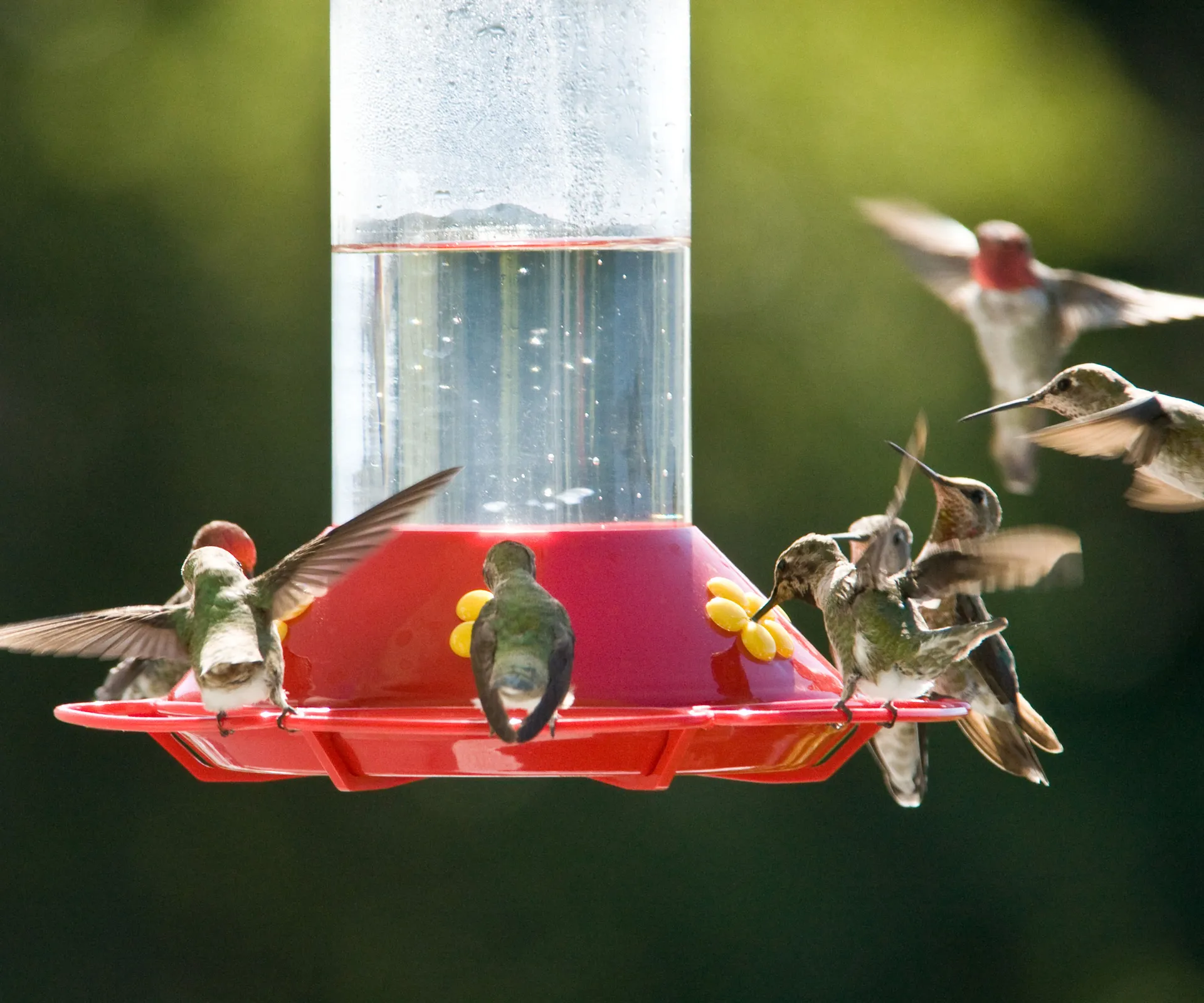
Prepare for hot August weather by making sure you refill feeders regularly, especially if you don't have a regular supply of nectar offered by red and orange flowers in the garden.
'Be sure that you fill and refill your hummingbird feeder frequently with a 4:1 solution of water to table sugar (not honey or brown sugar) that does not have red dye added. The red parts on commercial hummingbird feeders are more than enough to attract the birds, and red dyes can be harmful to them,' says Robert.
You can make up a supply of sugar water and keep it in your refrigerator for up to a week. Be sure to change the water in your feeders regularly, and clean them well between every refilling, at least every 2-3 days to prevent harmful bacteria and mold from developing. If it's very hot change the water every other day.
'Many people mix sugar and water over heat, with some thinking it needs to boil,' says August. 'Actually, it's as simple as stirring the sugar into hot water until it dissolves, which usually takes just a minute or two.'
Resist the urge to make the solution sweeter as this will make the hummingbirds thirstier, and August is such a dry month anyway. Instead try hanging a piece of fruit in a mesh bag to attract fruit flies, as insects are a major part of a hummingbird's diet too. Find out how to clean hummingbird feeders to keep these garden visitors happy.
Shop Hummingbird Feeders

The Aspects HummZinger Ultra Feeder is designed with both beauty and function in mind. With a 12oz nectar capacity, it’s the perfect size to place multiple feeders around your yard at migration time to feed as many birds as you can.

This hummingbird feeder is the perfect way to invite nature’s most beautiful flyers into your yard. The bright red feeder is designed to catch the eye of these tiny wonders. Simply fill the 4-in diameter feeder with nectar and place it in the ring

This vintage-style hummingbird station features five flower-shaped feeding ports to accommodate multiple hummingbirds. The feeder has a wide-mouth opening and flat bottle for easy filling and cleaning.
4. Set Up A Mister Or Other Cooling Treat

'Water matters enormously, particularly if you live in the desert,' says Siobhan. 'Hummingbirds don’t simply use water the way larger birds do. I’ve watched them fly through a fine spray from a hose, hovering in the mist and getting their feathers wet. A gentle mister or moving water source can provide both drinking and bathing opportunities while also helping birds cope with intense heat.'
We fully recommend the Mademax solar bird bath fountain, available from Amazon. It's quick and easy to set up and turns a bird bath into an oasis for hummingbirds.
Try this Garden Hose Misting Nozzle from Amazon, which has an adjustable water spray pattern that includes delicate misting for cooling down hot birds.
Another idea is to offer shallow bird baths to bathe in as it's a great way to help hummingbirds beat the heat. When watering flowers as temperatures rise, especially if there isn’t normal rainfall, sprinkle water onto shrubs too as hummingbirds in August will enjoy sitting on the cool leaves to escape the heat.
Hummingbirds are attracted to yards that have food sources and a good mix of sun and shade, and they need a safe perch to sit on in between their meals, so a small tree or shrub near your feeders is also a good idea.
Always make sure there is a supply of fresh drinking water available too. 'Another essential need for hummingbirds is a clean water source,' says August. 'Yes, sometimes they just need a good old-fashioned drink of water or even a little bath or shower. Having a water feature or modest fountain within sight of your hummingbird feeder fulfils this need beautifully, especially during prolonged summer heat.'
5. Resist The Urge To Start Pruning The Garden

'I recommend that gardeners and landscapers resist the urge to do major pruning in August simply because summer is winding down,' says Siobhan. 'Hummingbirds may still be using shrubs and trees for shelter, and maintaining layers of vegetation gives them places to rest between feeding flights.'
Another important consideration for hummingbird migration in August is not to remove late-season flowers either. 'In our Arizona garden, penstemon, bottlebrush and salvia provide important nectar sources, and I like to keep them flowering for as long as possible,' says Siobhan.
These heat-tolerant plants can be especially valuable for hummingbirds in August, when the weather is brutally hot and natural nectar sources may be harder to find. 'I also encourage gardeners to plant for a succession of blooms so hummingbirds have something available as the seasons change.'
Discover more tips on how to care for hummingbirds in August in The Hummingbird Bible by Rowan T Wiedemann, available here from Amazon.
One final tip on how to care for hummingbirds in August: the amount of pests and predators in the garden escalates in high summer. Bees numbers rise in August and September, and they will of course be attracted to the nectar in the feeders.
Find out how to keep out ants, as well as preying mantis and spiders – all will be attracted to the feeders. Keep a close eye on them. Use easy to clean, low maintenance, ant and bee proof feeders. If racoons are a problem in your area bring the feeders in at night.
Love inspiring garden ideas, outdoor advice, and the latest news? Sign up for our newsletter and get the latest features delivered straight to your inbox.
