What Hummingbirds Need in July – 6 Ways To Support Adults And Fledglings
Avian experts advise how best to help hummingbirds and their young as the heat intensifies


It's widely known that hummingbirds need support at key times, such as spring and fall when they're migrating. However, July is an important time for them too.
It's obviously hot and dry in many states, but that's not the only reason these acrobatic avians need a little extra help. Many hummingbirds are still nesting, and their young will be fledging.
If you've been attracting hummingbirds to your yard, there are some small actions you can take that will have a huge impact on the survival of this generation – and the next. Here's what hummingbirds need in July, according to avian experts (picking up a hummingbird feeder from Amazon is a good place to start.)
6 Ways To Support Hummingbirds In Peak Summer
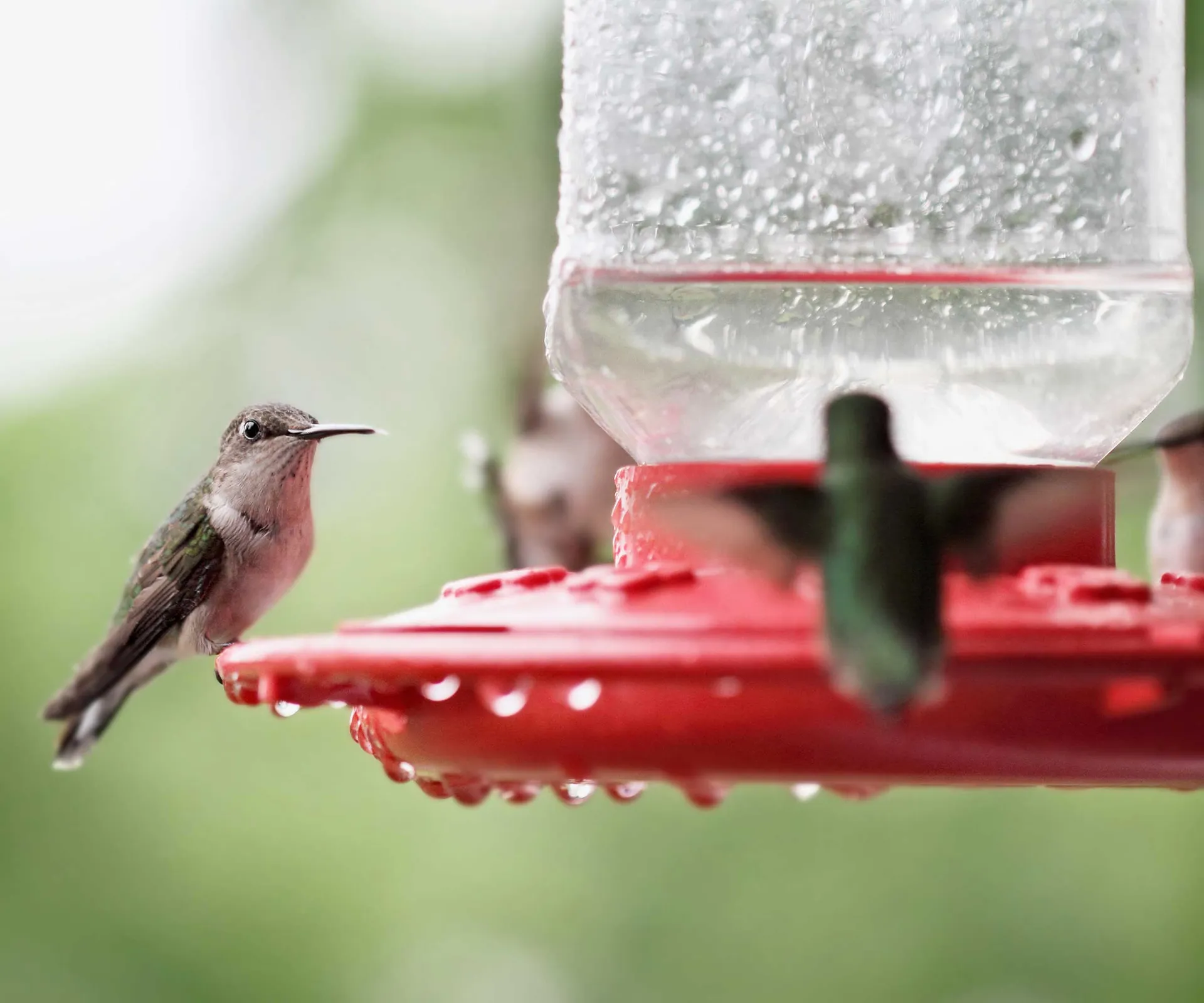
'July is a key time for hummingbirds (and enthusiasts) because young hummingbirds are fledging from the nest and visiting feeders, many for the first time,' explains Julie Zickerfoose, author and advising editor, BWD Magazine.
'Some fledglings literally have no idea what they are supposed to do. And aggression from older, more experienced hummingbirds is at a peak.'

Julie Zickerfoose is a wildlife artist, writer and advising editor to BWD Magazine (formerly Bird Watcher's Digest). She has spent her life, writing about birds, drawing and painting them, healing them when they’re sick, and raising them when orphaned. Julie is also the inventor of WarblerFall, a bird Bath that birds want to use.
1. Cluster Feeders Together

The usual recommendation on where to place hummingbird feeders is to spread them around your yard to prevent aggression and territorial behaviour. However, Julie recommends rearranging feeders so they're closer together – and using those with multiple ports.
'It's counter-intuitive, but instead of placing feeders all over the yard widely separated, to reduce aggression, what works best is to gang the feeders together,' says Julie.
'Choose large feeders with lots of ports and space them a few inches apart from each other. When there are lots of ports on one feeder, there are more chances for multiple birds to feed together.
'One aggressive male hummingbird can't possibly defend them all. When feeders are clustered close together, the fighting virtually stops.'
This Perky Pet Hummingbird Feeder from Ace Hardware has six feeding ports. Grouping several of these together, should increase access and safety for fledglings and youngsters.
2. Don't Fill Large Feeders To The Brim
It's vital to keep hummingbird feeders clean, but especially so during the height of the summer. One way to prevent nectar solution from spoiling is to monitor your feeders and top them up several times a week.
'It's important, when using large feeders, not to fill them to capacity unless you have a real crowd,' says Julie. 'Just put in as much nectar as the birds will finish in a day or two. You'll figure out how much that is by trial and error.
'The worst thing you can do is fill a feeder and forget about it for a week or more. In summer's heat and humidity, molds and yeasts will form very quickly, souring the solution and causing a risk to the birds. Cleanliness is paramount.'
When the feeder is almost empty, take it down and wash it thoroughly in hot, soapy water. This Dr Bronner soap from Ace Hardware is concentrated with no synthetic detergents, so you only need a tiny amount, and it's biodegradable. Rinse thoroughly, and refill with your nectar solution.
3. Avoid Cutting Shrubs

Gardening for wildlife can sometimes be at odds with traditional habits for keeping everything neatly clipped. If you can resist the urge to tidy shrubbery, it can benefit hummingbirds hugely.
'It's important to not hack down your shrubs at this time,' cautions Erika Zambello, Communications Director, Audubon. 'Hummingbirds often use them for nesting or for shelter, especially in hot weather.'
Native shrubs like this Viburnum from Plant Addicts make popular hummingbird nesting sites and provide these tiny birds refuge from the heat.

As Communications Director for Audubon Florida, Erika coordinates engagement, communication, and publications for the Sunshine State's conservation, coastal, policy, research, Center, and sanctuary programs. Based in Tallahassee, Erika works across the state to tell stories of resiliency, and how birds and people are affected by climate change, development, hurricanes, and more. Erika holds a bachelor's degree from Cornell University, and master's degrees from Duke University and the University of West Florida.
4. Plant For A Continual Bloom Cycle

If you know how to attract hummingbirds to your yard, you will have likely planted for a continual bloom cycle that lasts from spring through to fall. However, if you haven't, it's not too late to add more colorful container plants, to boost the blooms hummers feed on.
'Planting native plant varieties that bloom consistently in July is highly beneficial to hummers,' says Erica. 'If you’re in USDA hardiness zones 8-11 (the Southwest up through coastal Oregon, the Gulf Coast, and the Southeast up through North Carolina) planting firebush will offer a great July bloom that will satiate hungry hummingbirds.'
Erica tells us that her colleagues in Maine recommend Wild Bergamot (Monarda fistulosa), for New England and the Midwest. 'It begins to bloom in July and is a favorite for hummers,' she says.
'They also recommend a number of native honeysuckles for June and July, and later in the season, Orange Jewelweed (Impatiens capensis) and Cardinal Flower (Lobelia cardinalis). If you don't already have these plants in your garden, they can be grown in containers.'
This potted Black Truffle Cardinal Flower from Nature Hill's has showy red blooms that hummers love. It's best suited to those who receive plenty of rain as it loves moist soil.
For drier regions, this Lime Sizzler Firebush from Plant Addicts provides summer blooms. In colder zones it can be grown as an annual, or in pots and brought in before the frost hits.
5. Ensure Bird Baths Are Clean And Topped Up With Fresh Water

It's vital that bird baths are kept clean and regularly filled throughout the year. However, with many parts of the U.S experiencing drought, this ramps up in July (and August), particularly as tiny hummers prefer shallow bowls, where water will evaporate quickly.
'Throughout most of the United States, July can be hot,' says Erica. 'Placing a bird bath with water near to feeders and plants and changing the water regularly is helpful. A misting device is an especially attractive water source for hummingbirds.'
Adding a solar fountain like this one from Walmart will help these acrobatic avians to keep clean and cool.
6. Avoid Using Pesticides

The amount of insects in our gardens increases in the height of the summer. However, many of these are beneficial bugs that can actually prevent 'pests' from devouring your Dahlias. Hummingbirds provide excellent 'pest' control too and insecticides reduce a vital food source.
'Hummingbirds need protein-rich insects that are also small enough for them to eat,' says Erika. 'Things like small spiders, aphids, gnats, ants, fruit flies and mosquitoes are an important part of their diet.
'Please don't use pesticides in your yard, as this can eliminate a significant food source for hummingbirds.'
The experts at Audubon remind us that insecticides kill all insects including fireflies, bees, butterflies, ladybugs, dragonflies and cicadas. Eliminating the beneficial insects that eat others can make pest problems worse.
To prevent an invasion, Audubon's advice is to reduce mosquito habitat, such as stagnant water sources, by dumping water from downspouts and emptying and refilling bird baths every 3-5 days.
Also removing invasive species like English ivy and Japanese barberry can help, as these plants can harbour mosquitoes and ticks.
What to Shop

This solar fountain can be placed in a bird bath to create a mist for hummingbirds to use. It has six nozzles with a customizable spray, so you can find the right one for your desired outcome.

This hummingbird nectar is ready to fill feeders, no diluting with water needed. It doesn't have any artificial dye and comes in a 64 FL Oz bottle. It should be kept refrigerated after opening to keep it in top condition.

This hummingbird feeder doubles as a wind chime, with multiple glass feeders that bum together in the breeze to create a soothing sound. As the light hits them, they also reflect beautiful colors.
These actions will not only help adult hummingbirds to survive the summer heat, they will support their fledglings' survival too, protecting future generations of these charming creatures.
If you love inspiring garden ideas, outdoor advice, and the latest news, why not sign up for our newsletter and get the latest features delivered straight to your inbox?
