7 Outdated Small Kitchen Rules That Designers Say You Should Actually Break When Space Is Tight
These less-conventional approaches will maximize functionality as well as create a beautiful scheme


They say rules are made to be broken, and it turns out, small kitchens are the place designers often throw out the rule book. When space is at a premium, taking the unconventional route is the most effective way to maximize looks and functionality.
When taking small kitchen design rules into consideration, decipher what makes sense for your scheme. A small kitchen doesn't always offer the space to be rigid with distance between appliances, or accommodate an island, for that matter, so the irregular choice might just make the most sense.
But which design rules can you ignore in a small kitchen? I've asked interior designers, and their responses are rather eye-opening.
7 Design Rules to Ignore in Small Kitchens
Designing a small kitchen comes with its own unique challenges, which are only made harder when you try to stick to rigid rules that don't take into consideration the way you use your scheme. And if you're going to ignore any of them, make it one of these seven, as suggested by interior designers who have seen and tried it all.
1. You Must Squeeze in an Island

A small work table or kitchen cart is a stylish way to add extra surface and storage space without taking over the footprint of your scheme.
In recent years, it's become the done thing to squeeze in an island wherever you can, even in a tighter footprint. And while there are plenty of small kitchen island ideas that may work, if you don't have enough space, it's a design rule you can totally ignore.
'The rules I break in small kitchens all have to do with islands,' says interior designer Bethany Adams. 'In the first instance, not every small kitchen needs an island. Space to walk back and forth will actually be a much more pleasant cooking experience in a smaller kitchen than bumping into an island every time you turn around.'
As much as an island can feel like a luxury, if it impedes the flow and function of your design, your kitchen will lack usability. It's more important to choose a small kitchen layout that maximizes the available space.
As a compromise, you could opt for a peninsula-style island or even introduce a portable kitchen cart (our Style Editor recommends IKEA’s FÖRHÖJA Kitchen Cart) or small work table, like in this design.
2. Pendants are the Best Kitchen Lighting

The Sophie Surface Light from Cedar & Moss in this kitchen sits high on the ceiling to prevent any visual divides, while still producing plenty of functional light.
Where there is a kitchen island, you will usually find pendant lights hanging above it. But even if you have enough room in your small kitchen for an island, it can be a more impactful choice to ditch these low-hanging lights altogether.
'My second island caveat for small kitchens is to forego the popular choice of overhead pendants. In a smaller room, having things hanging from the ceiling clutters the room. Focusing the view on an element on an outside wall, like the windows or pretty open shelving, will visually expand the space,' Bethany adds.
Instead, opt for a layered lighting approach. On the ceiling, a pretty flush mount offers functional illumination without the visual divide, then layer in wall lights, like the Sculptural Cone Sconce from West Elm, and countertop lamps for a stylish balance.
3. Avoid Big Statements

The diamond detail on the cabinets is a characterful way to bring texture into a small kitchen.
It's generally advised that in a small kitchen, you should scale down the features within it to feel proportionate and create the illusion of greater space. But for designers, it's a rule that blocks the opportunity for a beautiful design moment.
'The idea that ‘less is more’ in a small kitchen is one rule I often challenge. When space is tight, I actually like to go big on one considered design detail rather than playing it safe everywhere. That might be a strong motif, such as a graphic diamond detail we used in our Highgate project, or a bold, unexpected kitchen color choice. A single confident statement gives a small kitchen personality and presence, and stops it from feeling apologetic or purely functional,' says interior designer Laura Stephens.
'Taking this approach helps the kitchen feel fully integrated into the overall design of the home, rather than a forgotten or toned-down space simply because of its size. Going big on a design detail doesn’t have to come at the expense of functionality. The key is to keep the layout, storage, and circulation clear and efficient, and then layer the statement through surfaces, color, or pattern rather than through unnecessary clutter.'
4. Always Use Lighter Colors

Dark colors create the opposite of a boring small kitchen. A deep green deVOL color has been used in this space, but Farrow & Ball's Railings and Benjamin Moore's Hale navy are popular choices.
It's easy to fall into the idea of decorating a small kitchen to look bigger than it really is. But this can often lead to a scheme that lacks personality and feels like a bright white box. Instead, embracing the smaller proportions with a moody color can be the most impactful decision you can make.
'Contrary to conventional wisdom, dark palettes can actually create depth and dimension rather than making a kitchen feel closed in. When used thoughtfully, on cabinetry, walls, or even ceilings, darker tones blur visual boundaries, allowing the eye to travel and making the space feel more expansive and intentional,' says interior designer Becky Shea.
'In tight kitchens, especially, depth is often more impactful than brightness, resulting in a room that feels layered, sophisticated, and thoughtfully designed rather than simply small. Breaking this rule can completely transform how a small kitchen is experienced. Darker tones tend to create a more intimate, romantic atmosphere while adding visual richness and depth,' she adds.
You still need to get that balance of style and function right, so how you introduce these darker kitchen colors is key. And for Becky, it's about choosing features that bring a deeper tone while offering a practical benefit.
'I focus on backsplash and countertop materials that feel sultry and rich in tonality, while still being driven by durability and ease of maintenance. Thoughtful lighting, reflective surfaces, and clear work zones further support functionality, creating a space where form and function are in harmony rather than at odds.'
5. Maximize Wall Space with Cabinetry

Open kitchen shelving is a great small kitchen storage solution that also serves as a decorative feature. To elevate your shelves, upgrade your brackets to something more elegant, like the Winona Shelf Bracket Set from Rejuvenation.
The general rule of thumb in a small kitchen is to prioritize storage and vertical space. But walls filled with bulky upper cabinets, which may appear practical, can create an imposing atmosphere in your kitchen. So it probably comes as no surprise that most designers like to break the design rules and not have kitchen wall cabinets.
'In a small kitchen, I often advise against filling every wall with overhead cupboards. While it can feel like the sensible option, too many wall units can make a space feel top-heavy and cramped. Instead, I like to introduce open shelving in key areas, which instantly lightens the room and adds character. It also encourages you to be more considered about what you use and display day-to-day – something most of us could benefit from,' says Melissa Hutley, interior designer and founder of Hutley & Humm.
'Removing banks of overhead cabinets creates breathing space and allows personality to come through. Rather than walls of identical cabinet fronts, you gain the opportunity to introduce small but meaningful details – a piece of artwork, a potted plant, or stacks of collected plates and glasses. These elements bring warmth and life to the kitchen and stop it from feeling overly uniform or soulless,' she explains.
It's a rule people can be hesitant to break because they feel they need all of that extra storage, but Melissa explains that this approach to small kitchen design is more functional than you might expect. 'You’re not necessarily losing storage – you’re just being more selective about what you store and where,' she explains.
'By combining open shelving with well-planned base units and thoughtful internal storage, the kitchen can remain highly functional. It’s about prioritising the items you genuinely use and love, while creating a space that feels practical but also relaxed and lived-in.'
6. Follow the Kitchen Triangle Layout

In this kitchen, the stove and sink are closer together than the usual rules dictate, but ignoring the typical work triangle rules has made the most of the available space.
If there is ever a time to ignore the kitchen triangle, it's in a small kitchen. There might be ideal distances to maintain between your cooktop, sink, and fridge, but you can't magic extra square footage out of nowhere.
'In small spaces, practicality has to take precedence, and a more compact, intuitive layout often works better than rigidly following the classic triangle rule. It allows you to focus on optimising what you actually have rather than trying to force a standard layout into an undersized room,' says Carina Raymond, founder of Studio Raymond.
'Compact appliances, such as slimline dishwashers, along with integrated under-sink bins, also help maximise functionality without overcrowding the room. While there may not be space for a traditional pantry, clever internal storage solutions, like compartmentalised drawers or spice racks on the back of cupboard doors, can make a small kitchen incredibly efficient.'
7. Scale Everything Down
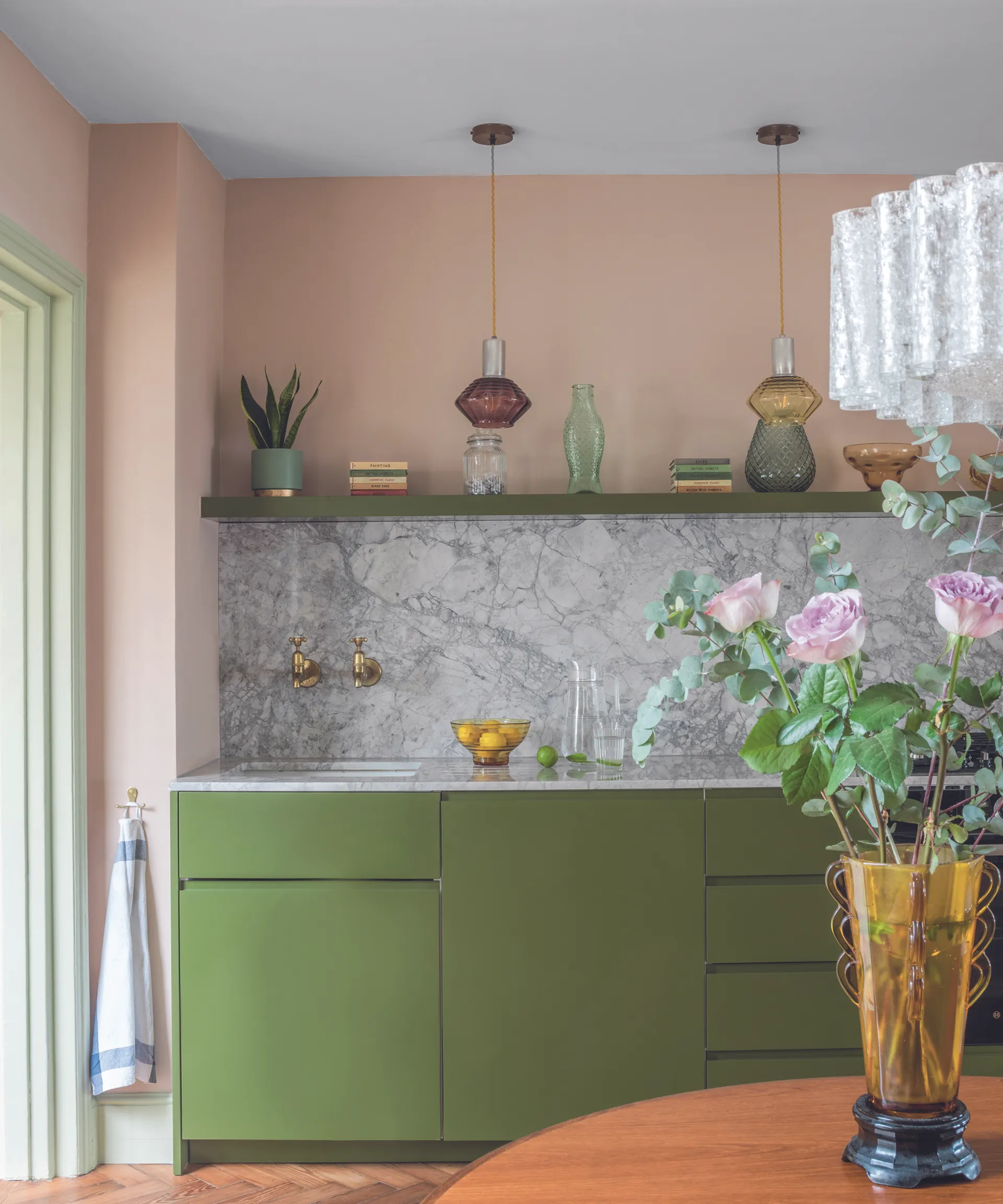
This one-wall kitchen proves small doesn't have to mean crowded. The larger cabinet scale instantly makes the kitchen appear larger, further helped by the slab-front design.
Scale in interior design is always a big talking point, but contrary to popular belief, a small kitchen doesn't mean you have to scale down the size of your cabinetry. For many designers, the complete opposite works much better.
'Rather than breaking a hard-and-fast rule, we often challenge the assumption that small kitchens need lots of narrow cabinets. In tighter spaces, opting for fewer, wider cabinets creates cleaner lines and reduces visual clutter, which can instantly make a kitchen feel calmer and more spacious,' says Sophie Pringle, founder of Pringle & Pringle.
'Using wider cabinetry minimises visual interruptions across the room and allows the eye to travel more easily, giving a greater sense of scale. Function always comes first. Thoughtful internal planning is key, from bespoke built-in pantries and integrated coffee stations to well-organised storage that makes full use of the available height and depth,' she explains.
'When layouts are designed around how the kitchen is actually used, simplified cabinetry enhances both usability and character.'
It's clear to see why these are the small kitchen design rules you should break when space is tight – they feel too rigid in a time when we are all trying to blend functionality with a personalized and characterful design.
Take the time to really think about how you use your kitchen, and which of these rules you can incorporate, and which you need to adapt or ditch altogether to make your cooking space work for you. For a more flexible approach, consider a few no-reno features that make small kitchens feel bigger, or even kitchen zoning – it's the designer-approved way to create a truly personalized layout.
